


Many of the “new” uses of the electricity grid in consumers’ homes are also flexible consumers: electric cars and heat pumps can adjust and shift their consumption. More and more solar PV inverters can also modulate their output in response to external signals or even pause completely. Stationary and mobile batteries can work in both directions. Existing electrical appliances such as hot water boilers are also fairly easy to control.
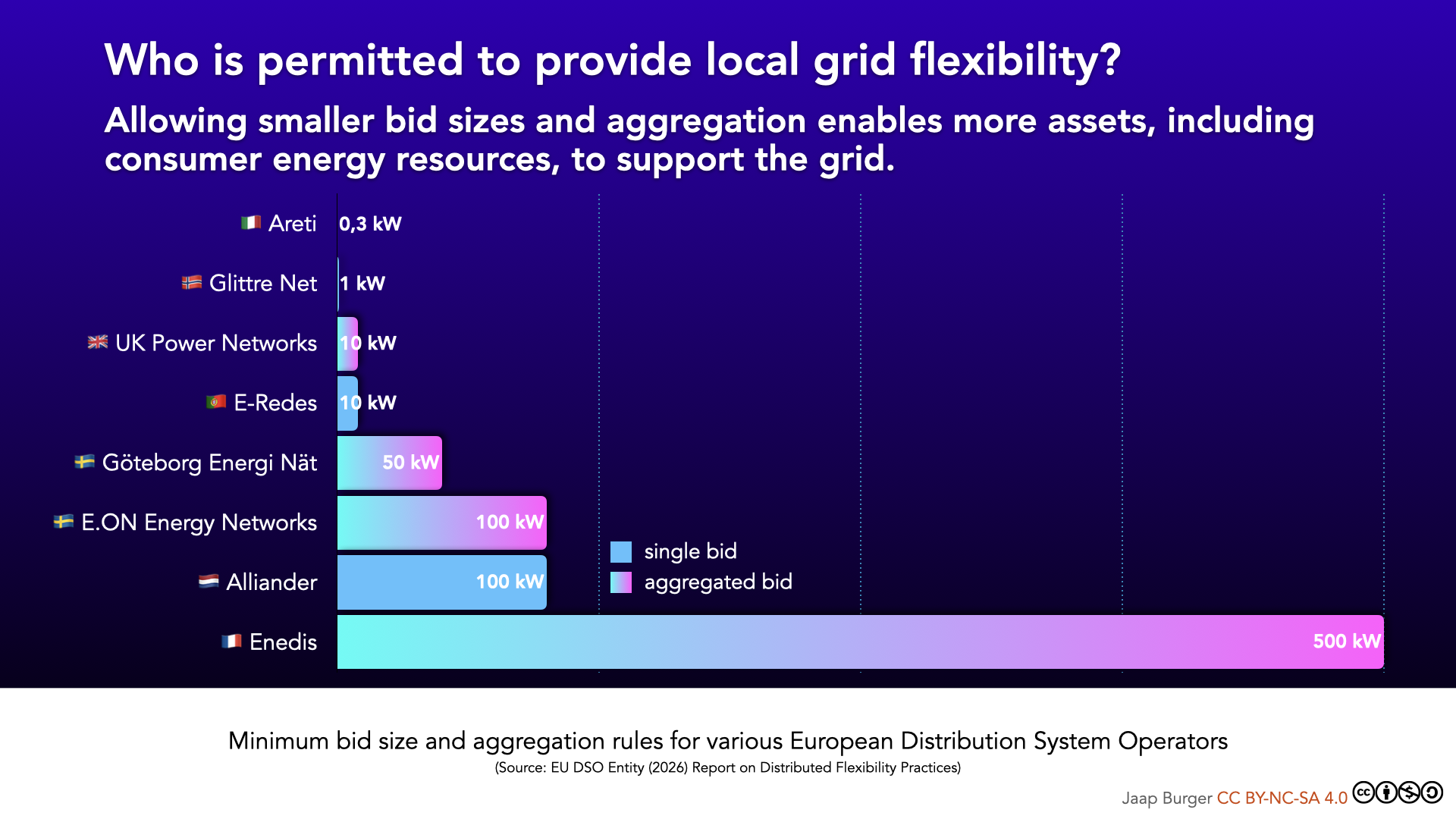
This can benefit users by reducing energy costs through better use of self-generated electricity and by taking advantage of varying prices on energy markets. In addition, these appliances can also easily provide flexibility for the national grid, or increasingly also for the local grid: with local flexibility markets, distribution system operators (DSOs) can use market-based flexibility as a temporary or permanent alternative to grid reinforcement (which cannot be realised quickly), in accordance with EU regulations. A report published today by EU DSO Entity discusses the current use of such platforms in Europe by various grid operators, and I used the information in the report to build this figure.
The choices DSOs make in this regard determine how much flexibility is actually offered, and thus also the price. Another relevant factor is the extent to which they use an existing platform or build something themselves. Thirdly, should aggregators be allowed to combine smaller units to create one larger force? The more participating network users – including consumers – the more liquid the market, and the more effective the deployment can be at lower costs.
Today also saw the announcement that in a large, central part of the Netherlands, there may also be no new grid capacity available for households, small businesses, EV charging, in the coming years – not because of average consumption, but because of peaks. There are too few large industrial consumers in the area to make agreements on flexible grid use, and above all, there are a great many consumers.
Which country in the table do you think the following applies to?
‘Currently, there is a lack of liquidity in the day-ahead and intraday markets, making it challenging to secure enough flexibility.’
High minimum bid sizes, no aggregation, a self-built platform. These are all choices. And that has consequences for who you burden with a problem and who you allow to help you solve it.