


A deeper dive into the cost of a public Megawatt charging point in the EU. Last week I published the breakdown of the number of charging points per recipient of funding from the latest CINEA – European Climate, Infrastructure and Environment Executive Agency call.
For CCS charging points (for cars and heavy duty vehicles) of up to 350 kW, the contribution was a fixed maximum amount per charging point. For megawatt charging points, a budget of eligible costs is used, for which up to 30% (and in the cohesion region, specifically for the Milence charging points in Poland, up to 50%) of the costs are supported under the AFIF. Are these all the costs? No, land, permits, administration, staff costs, studies, project management, OPEX, upgrades to existing infrastructure are not eligible and therefore not included in the budget calculation. Costs for local renewable energy production, storage and grid connection can account for 20% of the total eligible amount.
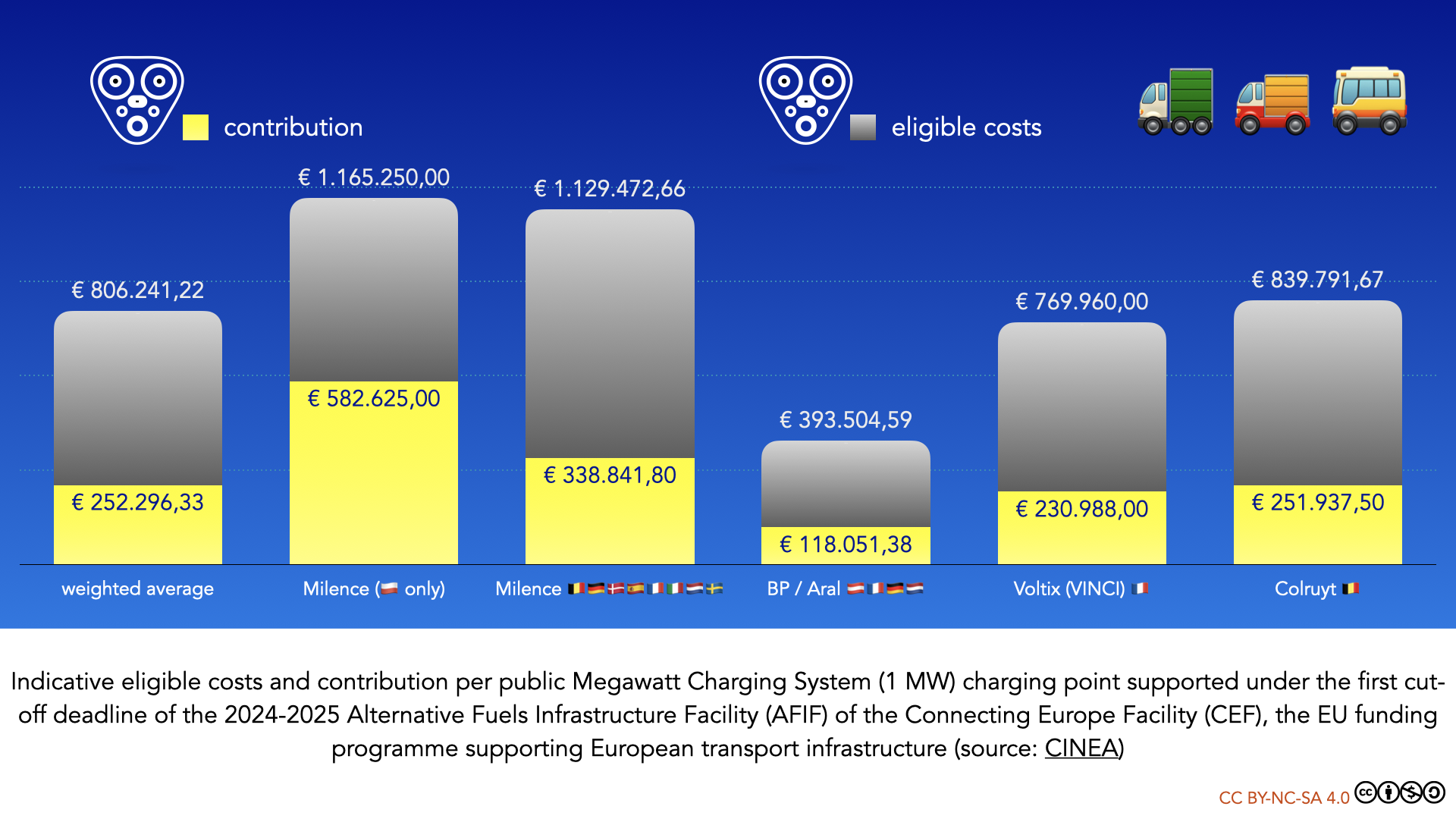
Working backwards from the amounts received – and taking into account the unit contributions for CCS chargers – this gives the amounts shown in this graph. This provides a rough estimate of the average cost of an MCS charger as part of a (small) charging hub. On average, 4 MCS chargers are implemented per Milence and Voltix site, 6 per Colruyt site, 7.5 per BP/Aral Pulse site. A clear outlier in terms of cost, half the average, is BP / Aral. It will be interesting to see if the costs converge in the next rounds.