


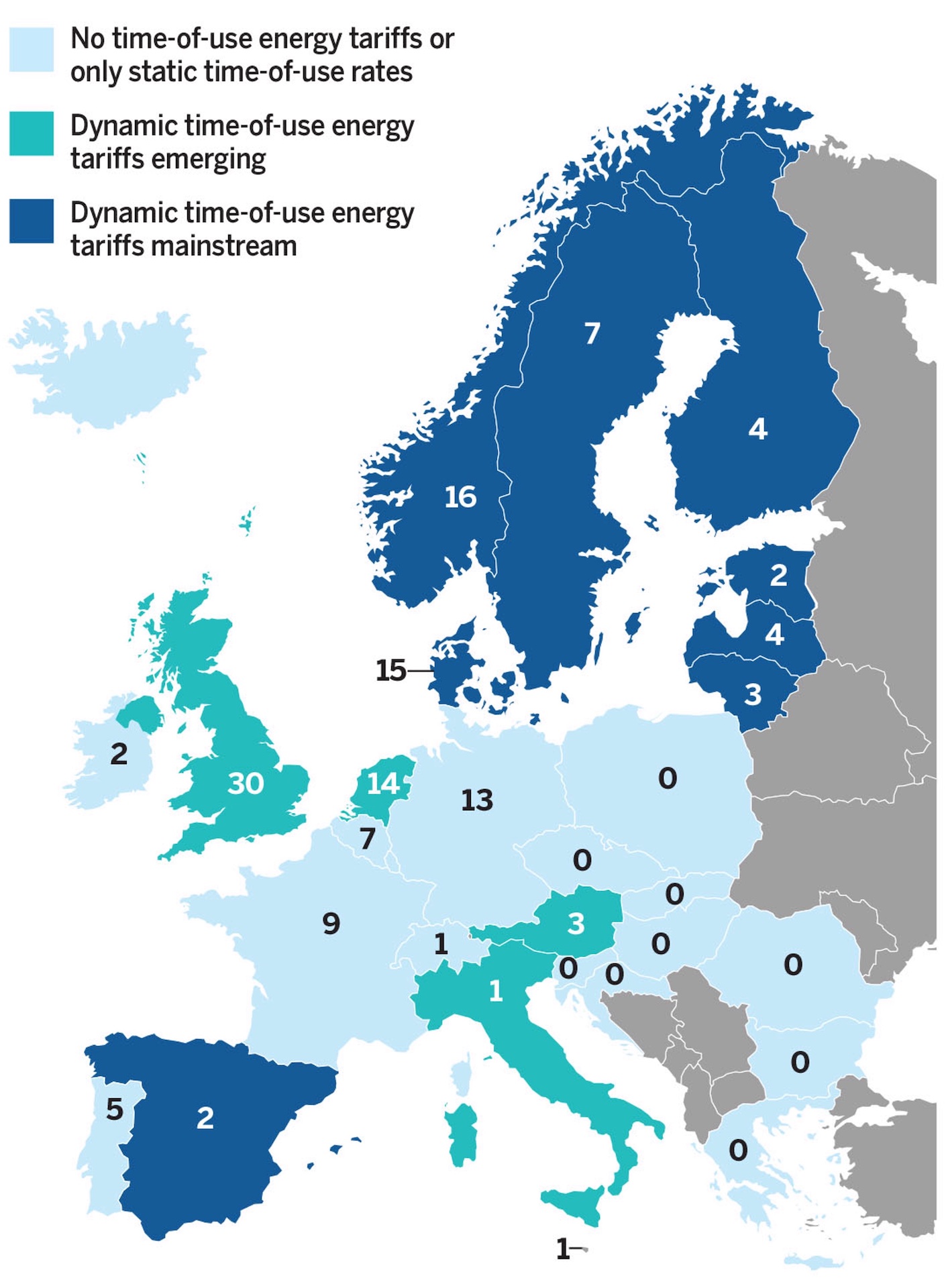
While in many European countries smart charging based on dynamic signals has yet to take off, in other places it is time for an evolution. This is what Norwegian grid operator Norgesnett is doing. In many European countries ‘first generation’ of smart charging has not even taken off due to a lack of smart meters and/or smart tariffs (from energy suppliers and/or grid operators). This map from my 2022 report on smart EV charging, shows this uneven landscape.
The ‘eNabo’ programme offers EV drivers (users with other flexible devices such as water heaters can also participate) a financial benefit if they manage to use local solar power, in addition to the existing optimisation for spot market prices. The compensation consists of the difference between the spot market price in the currently used hour and the cheapest hour of the day, plus a small bonus. A minimum monthly discount on the grid tariff is guaranteed for participation. Users benefit from participation but retain freedom and control. This increases the likelihood of widespread participation and thus the effectiveness of this programme in making more efficient use of the local grid and locally generated solar power. Without this shift in demand, either the grid would have to be expanded or inverters would be switched off, resulting in less renewable generation being used.
This is a good example of how ‘grid-aware’ can also be user-friendly and facilitate renewable energy. In many other cases in Europe, ‘grid-aware’ charging of EVs (or using heat pumps) takes an approach that is not immediately friendly: the focus is on limiting charging at certain times. Such schemes often use ‘energy clocks’ or ‘traffic lights’ rather than compensation, incentives, rewards that depend on actual grid savings achieved.
This different approach to ‘grid-aware’ aims to encourage consumption at times when the local grid is under high load from solar generation. As a beneficial side effect, this shifted consumption will not take place at other times. This has already been experimented with in Germany, for example, and in France the legal framework for energy communities provides for reduced grid fees for local use of local generation in the same time frame, but to my knowledge this Norwegian programme is the first one open to all consumers (in the specific grid areas). The challenge and great opportunity for Europe is to accelerate the necessary digitisation of grids and implement such solutions in other places where it is very much needed.
More information:
https://norgesnett.no/aktuelt/vil-du-vaere-med-pa-fremtidens-mate-a-dele-strom-pa-og-i-tillegg-fa-redusert-nettleie/ , https://norgesnett.no/kunde/forskningsprosjekter/enabo/ and https://e-nable.green/no/norgesnett/ (in Norwegian) and https://www.volue.com/news/volue-partners-with-norgesnett-to-reward-grid-aware-charging (in English by technology provider Volue)