


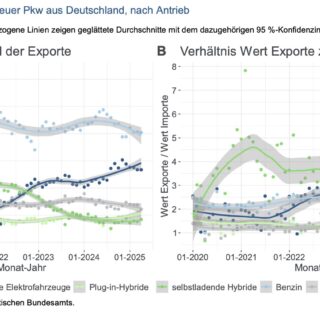
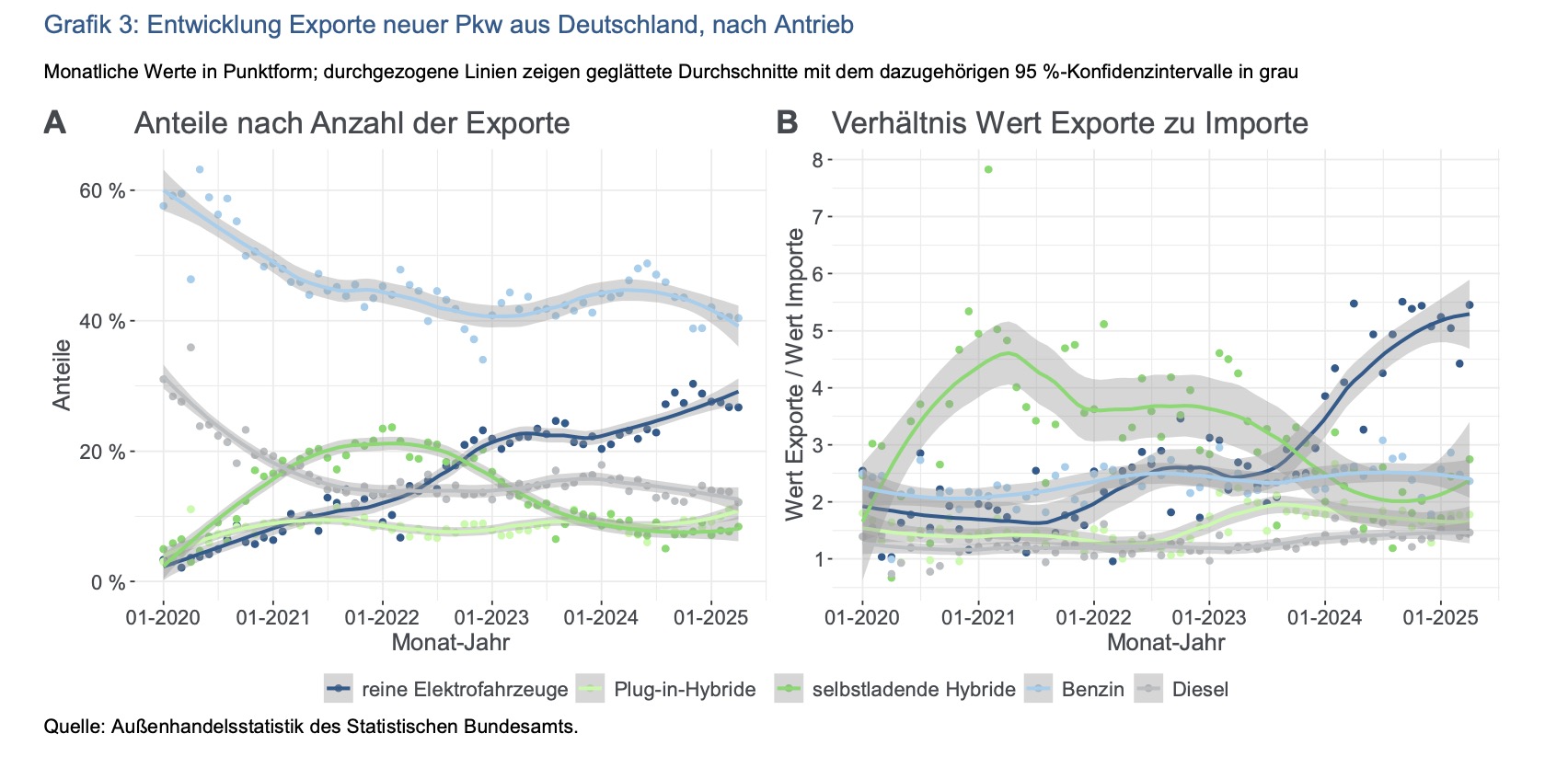
The German automotive industry’s best hope is electric cars. This is a fascinating graph from KfW Research (pdf: https://www.kfw.de/PDF/Download-Center/Konzernthemen/Research/PDF-Dokumente-Fokus-Volkswirtschaft/Fokus-2025/Fokus-Nr.-511-August-2025-Elektroautos.pdf) based on Statistisches Bundesamt (Destatis) data, shared by Jonas Schaible in his excellent newsletter.
What do we see here? Electric cars account for an increasingly large share of exports of cars produced in Germany 🇩🇪 : in the first quarter of 2025, they already accounted for 27% of exports. The second graph shows that the export/import ratio for electric cars is also significantly higher: Germany remains a net exporter of cars, but for electric cars, the ratio is twice as high (5) as the average for cars with combustion engines (2.5).
These electric cars are then exported to countries within the EU (50%), to the US (15%), the UK (13%), Norway (5%) and Switzerland (5%).
With such figures, it remains painful to see how German efforts (both industrial and political, although it is unclear where one begins and the other ends in Germany, as I wrote earlier) on the European stage are aiming to slow down the transition to electric vehicles and extend the life of combustion engines in new sales. A proper “Eigentor” (own goal ⚽🥅).
The KFW report (link in comments) also contains interesting data based on their Energiewendebarometer: more and more households are charging their EVs with their “own” solar power: 36% (and 44% via an external provider). KfW Research rightly points out the importance of making charging easier in multi-family dwellings, and the role of smart meters in particular, so that even those without their own solar power can charge cheaply and greenly through smart charging.