


It’s great to see the results of a field trial of dynamic pricing for public charging!
Centre for Net Zero (Octopus Energy Group) worked with charging app provider (or MSP in e-mobility jargon) Octopus Electroverse and tested the response of 110,000 EV drivers to different types of signals. Summary and full report via this Linkedin post.
Key findings:
1️⃣ EV drivers are highly responsive to public charging price signals.

A 40% price reduction led to a 117% increase in charging demand. A smaller price reduction of 15% still resulted in a 30% increase. Customers in lower income households show more elastic demand – an issue worth exploring further. Is this because they’re generally more price-sensitive and more dependent on on-street charging infrastructure? The report considers how bringing EV charging prices closer to the marginal cost of electricity could help =users without off-street parking, in particular, to bring their EV charging costs close to parity with the energy costs of fossil-fuelled vehicles. Rightly, policymakers and regulators – such as in France – are looking to better align energy market prices and EV charging prices to increase the affordability of EVs for wider user groups by ensuring that many can benefit from the charging flexibility of their EV.
See e.g. on France:
2️⃣ Price signals create demand at discounted chargers during periods of high renewable generation, rather than displacing demand from other available charging points.

As a charging point operator, do you not pass on low wholesale prices (or local grid flexibility events)? Users could charge elsewhere.
The report considers how not only wholesale energy markets but also distribution system operators might be willing to incentivise, for example, increased demand during periods of high local renewable generation. This is something being explored, for example, by the GRIDS & BENEFITS project in Germany:
and in Norway, where a DSO pays EV drivers to charge during the day:
3️⃣ Significant consumer welfare gains from dynamic pricing.

For consumers without access to home charging, it offers the potential to reduce the running costs of EVs to levels comparable to – or below – those of petrol vehicles.

That’s really important, because the cost of running an electric vehicle – at the moment – depends very much on whether a driver has access to off-street parking and an off-peak tariff. Those who rely on public charging infrastructure pay significantly more.
It shows that ensuring that price signals reach users is key to making smart charging a success. As Amsterdam’s on-street smart charging bonus with a close CPO – MSP collaboration shows, this is the key to large-scale participation and thus highly effective demand shifting.
What can policymakers do?
Last year, we produced a short guide for policymakers to help them understand what they can do to enable the benefits of public smart charging:
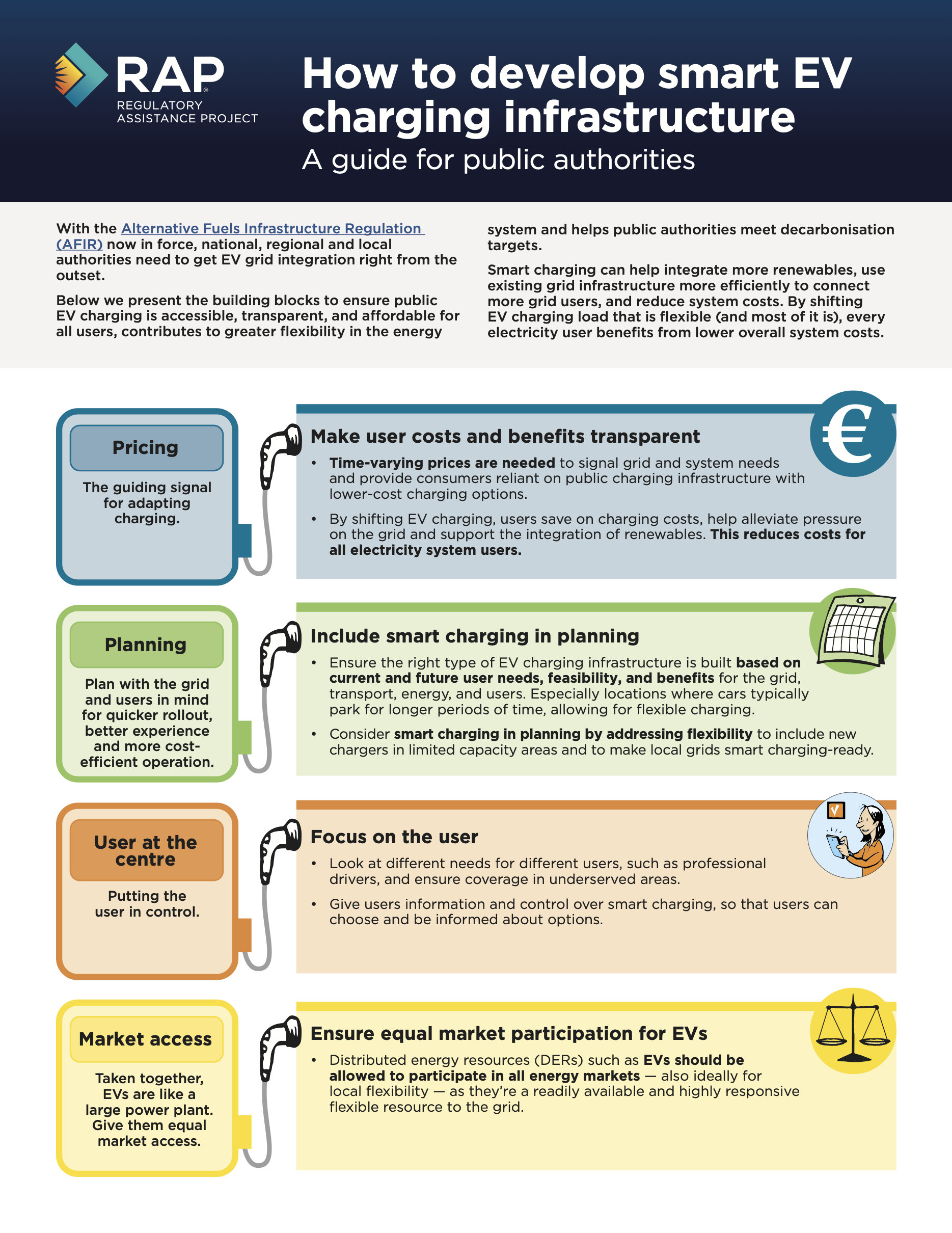
This report from the Centre for Net Zero provides welcome evidence of the demand elasticity for public EV charging, and plenty of food for thought on how to take this forward from an equity perspective, to make flex participation easy and risk-free for everyone, to increase CPO business, and for overall welfare.
Whether it’s cities procuring public charging infrastructure, charging point operators looking to improve their utilisation and turnover rates, national and European policymakers and energy regulators paying attention to public EV charging, or distribution system operators looking for more flexibility in their grid, there’s no way around ensuring that users of public charging infrastructure can benefit from the flexibility.